
[pdfwp_tool tool=”pdf-style-editor”]
Introduction
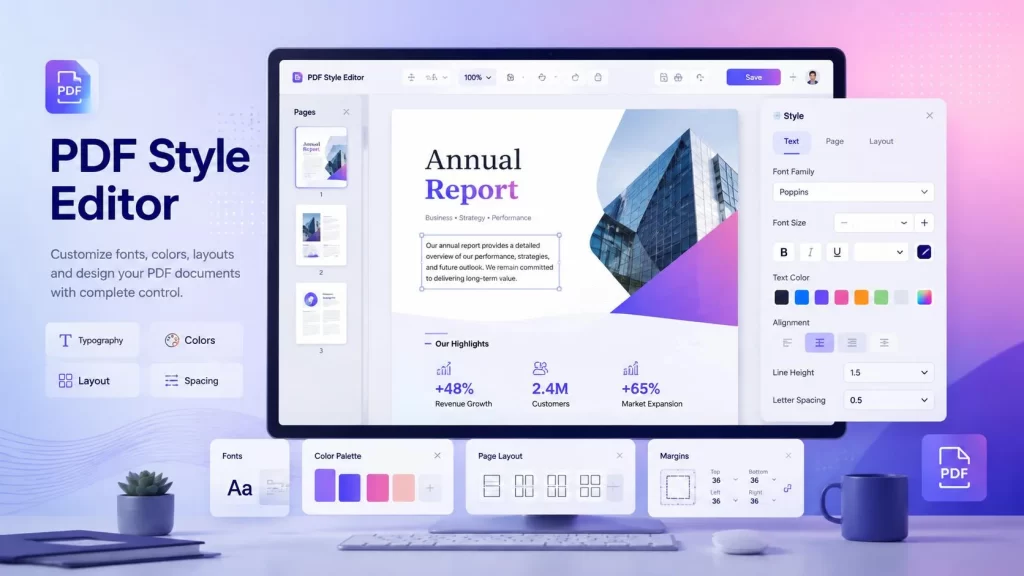
A PDF Style Editor is software designed to make alterations to the looks and layout of a PDF file. Rather than recreating your PDF from scratch, you can use PDF editing software to alter text, fonts, shading, spacing, layout, and more of the original material.
This type of document file is widely utilized for:
- Company reports
- Resumes
- Ebooks
- Accounts
- Types
- Brochures
- Assignments
- Guides
- Proposals
- Marketing and advertising materials
- Training or instructional documentation
However, having a PDF doesn’t guarantee it’s beautifully designed with consistent wording, headings that reflect hierarchy levels, and appropriate colors. PDF formatting resources offer solutions to problems related to inadequate text layout. A trustworthy PDF style editor can significantly enhance document quality, whether you’re editing a business document to appear more convincing or revising a manual or brochure that looks outdated.
What Will I Amend Having a PDF Style Editor?
While abilities vary depending on the software used, typical editing features include:
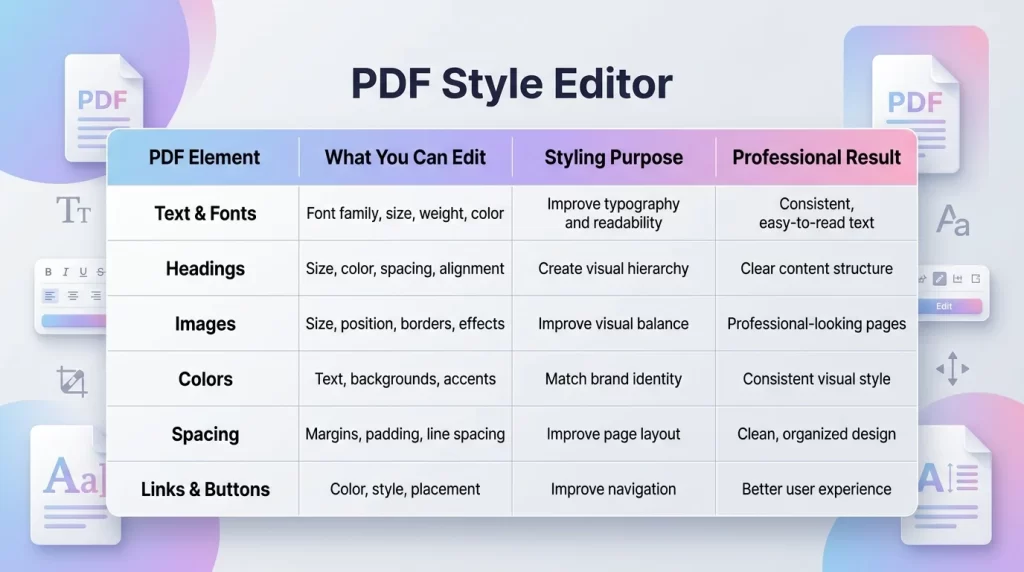
| Feature | What You Can Do | Primary Benefit |
|---|---|---|
| Text | Font, scale, design, coloring, spacing | Increases intelligibility of text |
| Headings | Scale, heaviness, coloring, position | Improves overall look and structure |
| Images | Scale, placement, change | Enhances document visuals |
| Background | Coloring or picture | Enables graphic consistency |
| Pages | Scale, order, margins, format | Supports structural organization |
| Headings & Footers | Text, page numbers, branding | Aids data structure and professionalism |
| Tables | Placement, limitations, spacing | Improves readability of detailed data |
| Links | Target and look | Assists with navigation efficiency |
An expertly curated document comprises a balance between accurate information and its aesthetic presentation.
Why Use a PDF Style Editor?
1. Maintain Firm Branding
Organizations often maintain consistent tones, fonts, logo types, and internal spacing across their documentation. A PDF editor style resource helps sustain that standard:
- A dedicated color scheme for headings
- A standard family of text fonts
- Provider brand in the headings
- Unique pagination
- An orderly margin system
- A matching design for tables to develop a coherent visual brand image
2. Boost Clarity of Reading
Excessively small typography makes even the finest articles difficult to read. Using a PDF style editor allows you to:
- Create clearer textual structure
- Increase text height
- Vary paragraph widths
- Raise title sizing
- Align text and improve contrast ratio between font and backgrounds
3. Save Time In PDF Style Editor
Making even small formatting changes shouldn’t require tedious rebuilding of a comprehensive document from scratch. Simply changing a title, fonts, or page background can significantly speed up your workflow.
4. Make Professional Documents By PDF Style Editor
When your proposal documents contain excellent information, clients will evaluate quality based on how your documents look. Professional appearance builds trust and credibility.
Key Features of the PDF Style Editor
Writing and Font Changing
When using PDF editing solutions, the primary need should be to modify text formatting without disrupting the surrounding layout. Essential text features include:
- Style of font
- Font size
- Color mixing (black, white, yellow, etc.)
- Character spacing adjustments
- Text placement
Note: PDF text has become more complex, with sophisticated page structures and integrated fonts. The resulting PDF may not react like a typical writing program. For major structural changes, it’s often more prudent to use the original software (e.g., Word or Photoshop).
Shading Options
Color choices attract the eye and influence PDF design. Whether for design purposes or creating eye-catching graphics, a PDF Style Editor allows you to:
- Change text colors
- Modify background tones
- Adjust element colors, border-lines, or highlights
Best Practice: Stick to your firm’s logo colors and limit yourself to around 3 shades throughout any document.
Layout & Size Changing
PDF editing tools help you:
- Resize pages
- Rotate pages
- Move pages around
- Cut pages down
- Create uniform and steady page style backgrounds
This is useful when altering combined files, report paperwork, and arranging documents in logical ways.
Headings & Bottom Element Enhancing
Headers and footers add value without detracting from written content:
- Titles
- Company name
- Phone numbers
- Place data
- Private branding info
- Websites
- Page numbers
For lengthy, organized documents, the ability to manage page numbers can save hours of work.
The PDF Style Editor vs. The PDF Editor
Although the terms are often used interchangeably, there are distinct differences:
| Aspect | PDF Editor | PDF Style Editor |
|---|---|---|
| Focus | Broad modifications | Visual appearance tweaks |
| Changes | Original content modifications | Layout and aesthetic adjustments |
| Best For | Comprehensive editing tasks | Maintaining professional, consistent documents |
A PDF editor usually implies a broad modification package, while a PDF style altering tool focuses specifically on changes to how the document looks.
Step-by-Step Information
Step 1: Evaluate the Original PDF Document
Before changing anything, examine your whole document thoroughly. Look for:
- Diverse font styles
- Inappropriate heading measurements
- Uneven spacing
- Incompatible alignment
- Weak font contrast
- Broken web links
- Bad margins
- Misaligned images
- Inconsistent company branding
Step 2: Establish the Desired Format
Choose what the final PDF will look like. For example:
- Business document: Single major font, a second font, 2-3 brand colors, consistent header sizes, standard margins
- eBook: Focus on text display and any brand style
- Brochure: Visual impact is more emphasized
Your chosen style must match the purpose of your PDF.
Step 3: Use Typography
Typography plays a large role in user experience:
- Read what the audience will be reading clearly
- Avoid too many font combinations
- Main header: Largest font with bold style
- Level two heading: Second bold size
- Level three heading: Smaller bold style
- Default style: Body content
Important Tips for Modifying PDF Font Files:
- Ensure the font type is readable
- Minimize font combinations
- Maintain layout for each heading style
- Always check font embedding for export
- Proofread on multiple device screens
- Ensure special characters are fine
Warning: If the current document uses a font unavailable on your device, replacing it will affect lines and paragraphs.
Step 4: Balance Color & Contrast
A PDF style editor can give a consistent color palette:
- Use bright-colored text on light backgrounds
- Use stronger accent colors for heads, buttons, and links
- Avoid text and background of the same colors (causes difficulty in viewing)
Step 5: Adjust Spacing and Alignment
Proper padding and alignment make PDF files look spectacular:
Standard distances needed:
- Between headings and paragraphs
- Between paragraphs and images
- Between images
- Between document edges
- Page headers to main content
- Page footer to content
Alignment makes things easy for the eyes to follow—don’t randomly place items.
Step 6: Configure Headers & Footers
A proper header and footer makes navigating long PDFs easy. Typical footer format:
text
Company Name | Document Name | Page 4
Other items to include:
- Date
- File version
- Confidential notes
Avoid unnecessary texts.
Step 7: Cleanse Images and Graphics
If images get deformed or are exported incorrectly:
- Ensure pixel resolution is fine
- Check image aspect ratio
- Verify position of each image
Step 8: Reconfirm Everything
Once complete, verify:
- Missing words
- Font changes
- Overlapping objects or text
- Wrong page numbers
- Broken links
- Damaged pictures
- Blank pages
- Bad alignment
- Wrong font color or margin
- Ability to open in another PDF viewer
Quality Assurance Process
Quality assurance guarantees integrity and presentation quality:
- Save the updated version
- Reopen in a new PDF viewer and proofread all pages
- Check all links and test download-files
- Check fonts and spacing
- Verify page numbering
- Test resolution and placement for images
- Check whether PDF can open normally
- Compare to the original
- Always maintain a backup of your original copy
PDF Style Editor or Desktop Software?
| Aspect | Online Version | Desktop Software |
|---|---|---|
| Installation | No download required | Download required |
| Ease of Access | Any computer with login and internet | Depends on device |
| Accessibility | Any platform | Files stored on your computer |
| Quick Edits | Very quick | Good for offline editing |
| Large Files | Slower | Better performance |
| Security | Depends on provider | More controllable |
| Features | Limited | Powerful (form creation, password protection, etc.) |
When is an Online Tool Best?
- Small files without critical information
- Only minimal formatting changes needed
- Need to prepare and send files immediately to clients
- Working while traveling
Best Practice forPDF Style Editor
Remember these key points:
- Save your original file – Before making major modifications, create a clone
- Standardize design – Pages must possess similarities that appeal to readers
- Limit effects – Avoid excessive use of colors, decorative fonts, and shades
- Identify essential elements – Preserve bookmarks, metadata, digital signatures, form fields, hidden layers, and documents
Note: The editing process might destroy some data or objects. Ensure they remain unchanged.
PDF Style Editor and File Security
When saving and printing PDF files, confidential information may be present but invisible (metadata, annotations, hidden layers). If submitting to external clients:
Remove these private objects:
- Comments
- Annotations
- Metadata
- Hidden layers/documents
- Forms and fields
- Digital signatures
Common Mistakes During PDF Style Editor
- Overlapping text/images – Makes content difficult to read
- Not following your audience – Use clear and readable fonts
- Excessive font combination – Affects whole document’s visual aspect
- Not considering small devices – Files may look fine on screen but fall apart on mobile
- Changing fonts without reviewing – Affects line breaks and page flow
- Wrong color and contrast – Many people cannot discern colors as others can
Benefits of Using a PDF Style Editor
With a well-managed workflow, a styling tool offers:
- Enhanced readability
- Better branding consistency
- Quick formatting updates
- Improved visual hierarchy
- Easier template customization
- Professional appearance
- More user-friendly navigation
- Greater document manageability
How to Select the Best PDF Style Editor
Ask yourself these questions:
- Does the software support your primary PDF file type?
- Can you change text and fonts within documents?
- Can you change colors?
- Can it maintain current layout and composition?
- Can you add headers or footers?
- Does it facilitate modification of images?
- Can existing links and forms be preserved?
- Does it contain security options?
- Does it operate both locally and via the web?
- What measures does it use to handle sensitive documents?
- Is it compatible with accessibility standards?
- Is your output PDF free of quality loss?
The right tool for the task may not be the one with the most features, but rather the one that works best with your specific document types and workflow.
PDF Style Editor for Various Uses
Business Documents
Organizations use it for branding reports, proposals, sales documents, and presentations.
Resumes and CVs
Improve fonts, layout, and visual hierarchy.
Educational Documents
Students and educators can quickly improve worksheets, tests, presentations, and assignments.
Marketing Materials
Optimize brochures, flyers, catalogs, and advertising documents.
Digital Books
Control typography, pagination, formatting, and navigation for e-books.
EEAT(Experience, Expertise, Authoritativeness, Trustworthiness)
Experience (Real-World Application)
The most critical test for a high quality PDF style editor is in your hand. Your experience with the editors, if you are applying style changes, resizing margins, relabeling headings, or resupporting pictures-they must be easy and effortless. This means they use the smooth, seamless interface (which takes a small time to be responsive but the process is very liquid during use) which makes the boring and repetitive things not boring enough! For that matter, as a creator of documents, the creator’s personal experience of all common design problems is necessary, it makes full use of this editor’s functions to bring up to 70-percent standard document from messy PDF documents in a professional and publishable form.
Expertise (Technical Knowledge of PDF Structures)
The creator’s ability of style treatment to documents on a deeper level of PDFs need to consider many details beyond just click-the-buttons; this means an understanding of PDF drawing engines of the font, object embed flow. An expert knows which function is necessary of directly editing PDF documents to not crash well-programmed vector diagrams and Interactive Form, but needs the original source files(Word, InDesign….)instead when complicated vector are too easy to damage. Also the PDF style editor needs to prove that its capability from the professional view point, especially toward preserving interactive form fields, true type vector graphs etc. With correctly embedded subset fonts so it can be looked no matter which operational systems, display.
Authoritativeness (Credibility of the Tool and User)
Your PDF document’s validity depends mostly on your usage of tools. Professional Desktop Application like Adobe Acrobat and trustable Online PDF Editor(with SSL protection) are regarded as possessing professional authenticity, therefore their functions should always provide valid professional output which makes client/boss totally convinced from appearance. A trusted PDF document is a document that comes from and is processed by trusted tool as well as a totally reliable and professional designer that makes all the documents obey the layout specification such as ISO (PDF/A,PDF/X) and error free in form, appearance presentation.
Trustworthiness (Data Security & Privacy)
Data security and trust are absolutely essential, regardless if you’re handling sensitive contracts, or some financial statistics or R&D materials.
Data Handling: Before you upload and use an online PDF editor, be extra sure with its privacy policy. Does your data permanently get removed after a specific duration? Is there any form of encryption?
Metadata Wipeout: Trusted PDF documents include clearing of data like author information, track changing, modify history before sending out the PDF documents; but also other private, or security sensitive hidden information.
Backup Recovery: One of the key points that one trusts a tool the is in no way the originality or style is damaged, your PDF style editing tool needs to have amazing “undo” and “recover” functions, while it always requires one to have a solid backup of the origin files of a non-manipulated and unedited nature, to make sure data doesn’t get corrupted.
Frequently Asked Questions
What exactly is a PDF Style Editor?
A PDF style editor is software that helps alter a PDF document by tweaking fonts, colors, layout, and visual elements such as images, texts, backgrounds, and headers/footers.
Does a PDF Style Editor let me change document fonts?
Yes, though this depends on how the original PDF was created and on font availability.
Can a PDF document’s colors be adjusted?
Yes, the vast majority of PDF styling tools enable altering font colors, backgrounds, outlines, and other graphics.
How do I change the appearance without altering the original layout?
While most apps are fairly good at this, some adjustments may inherently change document structure and arrangement.
Is it safe to use an online PDF Style editor for confidential files?
Security depends largely on the developers’ business practices. Always check privacy policies before using.
How do I resize a PDF page?
Lots of PDFs can be resized or cropped using a style editor.
Are headers and footers supported?
Most applications designated to work with PDF documents allow insertion of headers and footers.
What is the difference between PDF editing and PDF Style Editor?
PDF editing allows manipulation of document data (text content, links, images, structure). PDF styling focuses solely on the document’s appearance.
How do I make a PDF look professional?
Start with basic skills: use consistent fonts, layout, and formatting. Ensure your content remains readable above all else.
How do I back up my document before editing?
Always backup your original document before changing any element. This ensures you have a reliable copy to revert to if needed.
Final Thoughts
A PDF style editor simplifies the process of creating documents that look professional and consistent, without any additional complexity. With it, one can edit various aspects such as fonts, colors, spaces, pictures, headers, footers and the structure of pages on their PDF.
The secret to styling up a PDF stylishly is the consistent flow within the pages: chose fonts which are easy to read and clear with their size and form. Maintain hierarchy for headings; use color in a professional yet visually pleasing manner and consistent spacing throughout the document. Finally always make sure the modifications made did not alter the existing layout; i.e. Links, form fields, pictures, page numbers etc in the PDF document.
If it’s a sensitive document, the looks aren’t all that is important. Check and remove metadata, hidden data, annotation objects, annotations, multimedia clips and other necessary information from your file before sending.
Edit business report, resume, ebook, flyer, marketing documents with the right PDF style editor to ensure you save time and quality in no time! Do a check in every stage during the editing and final review process to provide a well designed, effective, accessible, and visually attractive PDF.